Stroppe Racing Broncos: The Birth of "Big Oly" by Todd Zuercher
As a rule, off road racers have generally assigned odd names to their vehicles. In today's lexicon, names like "Truggy" and "Arnold" roll off peoples' tongues without a second thought and most enthusiasts immediately know the vehicles being described. Perhaps it's the odd conglomeration of parts and pieces on these mechanical beasts that elicit such creativity when their names are generated.
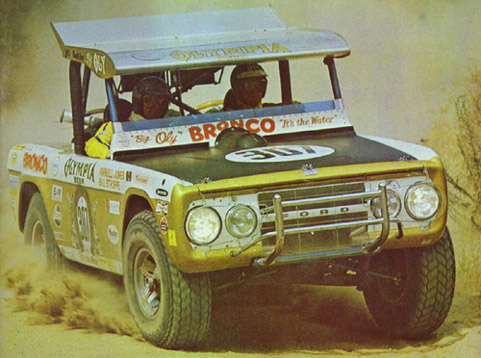
This naming convention is not a recent phenomenon. In the early days of desert racing, odd-looking vehicles with names like Wampuskitty, Bollweevil, and the Baja Boot bounced through the wilds of Baja in search of adventure at a much slower pace than today's fire-breathing mechanical monsters. In 1970, the first "funny car" of off-road racing, the vehicle which would become known as "Big Oly", was unleashed at the Mexican 1000 off road race and the field of competition was changed forever.
Parnelli Jones and Bill Stroppe first rode together in a Ford Bronco in 1968. Jones drove one of Stroppe's Mercury stock cars for several years in the mid-'60s and the familiar red, white, and blue Stroppe colors became a common sight in victory lane with the hard-charging Jones behind the wheel. Legend has it that Stroppe made a comment at Hot Rod publisher Roy Brock's Christmas party one year that he thought Jones wasn't man enough to race off road. This, of course, was Bill's way of provoking Parnelli in trying his hand behind the wheel of one of Stroppe's Broncos. Now the early Broncos were tough vehicles, but Jones drove the wheels off them, literally. The 4WD versions of the trucks frequently left wheels, hubs, axles, and other drivetrain parts on the course when Jones climbed into the driver's seat. The trucks' heavy front axles, the extra weight of the transfer case, and relatively high center of gravity did not blend with Jones' let-it-all hang out driving technique.
Temporary salvation came came in the form of a truck known as the "Pony". Simon "Bunkie" Knudsen's short tenure at Ford had produced, in addition to the Boss 429 Mustang, a 2WD Bronco study project with a lowered body, a Twin-I-Beam front end and an automatic transmission. Knudsen wanted to study the feasibility of selling a 2WD Bronco, but the project was scrapped and Stroppe ended up with the vehicle. According to Jones, he spied the vehicle sitting in the corner of Stroppe's shop and suggested they build it into an off road race vehicle. Stroppe complied and shortly after the vehicle's debut, Stroppe and Jones won the 1970 Baja 500 in the red and white Bronco. Parnelli liked the Pony but wanted more. The Pony still used a Bronco frame and Jones wanted a tube frame "truck" built to his specifications-faster, stronger, and lighter-something to "beat the bikes", he once said. According to Parnelli, he approached Stroppe about building such a beast, but Stroppe resisted because the vehicle really wasn't a Bronco anymore and he thought the vehicle should stay true to the production Bronco to keep Ford happy.
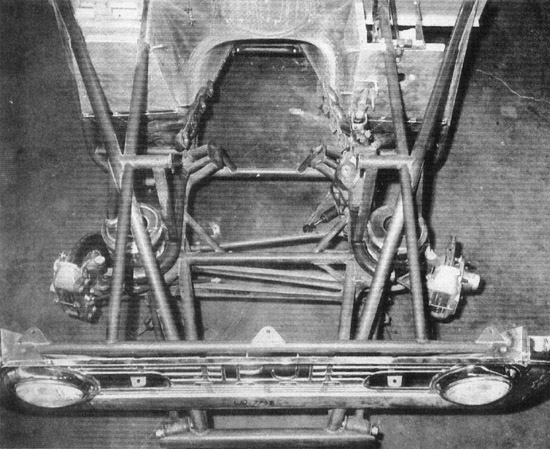
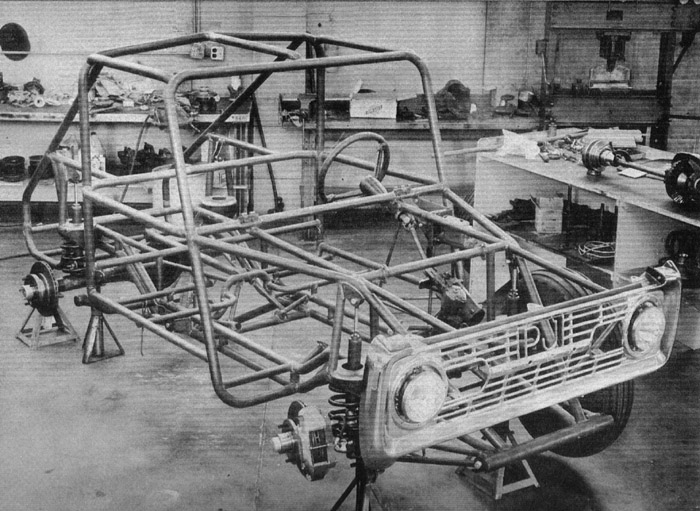
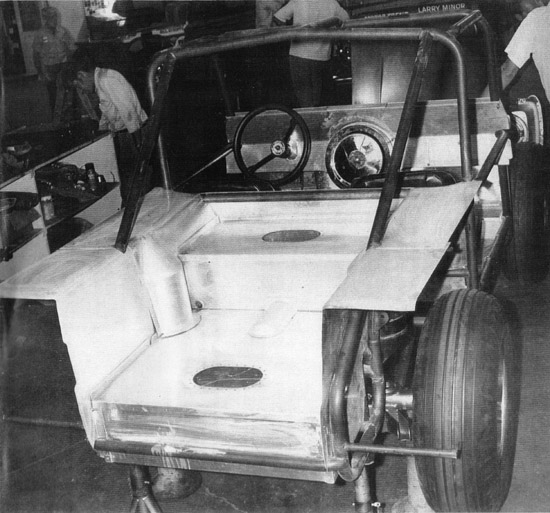
Parnelli took Dick Russell, a Stroppe employee and ace fabricator, to lunch and found a willing partner to design and construct the vehicle. They sketched out the designs for the tube-frame chassis on napkins and came up with ideas they wanted to incorporate. Russell started working on the truck at his home, away from the eyes and ears of Stroppe. Bill soon caught wind of what was happening though, and demanded to know what was going on. Though Bill felt like Parnelli had gone behind his back in building the truck, things were soon smoothed over and the construction of the project moved to Stroppe's Long Beach facility(where the accompanying photos were taken). With all differences aside, the build-up was finished at Stroppe's shop with only one casualty: Parnelli's checkbook! Holman-Moody-Stroppe charged much higher labor rates than Dick Russell did in his garage!
"Big Oly" was not the original name of this tube-frame wonder. The definitive book on Bill Stroppe, Boss, by Tom Madigan (an excellent piece), implies that "Crazy Colt" and "Big Oly" were two different vehicles, when in fact they were the same truck. "Crazy Colt" was the original name of the truck, as evidenced by the nameplate under the windshield area in the early photos. "Crazy Colt" wore Johnny Lightning(one of Jones' Indy sponsors) graphics at its first races. The truck underwent several graphics changes throughout its life but became "Big Oly" with the Olympia beer sponsorship within the first year of being constructed. The racing exploits of Big Oly are well-documented and recounted in many published works over the years. The photos shown here document the build process and shed some light on what was an incredibly high-tech vehicle thirty years ago.
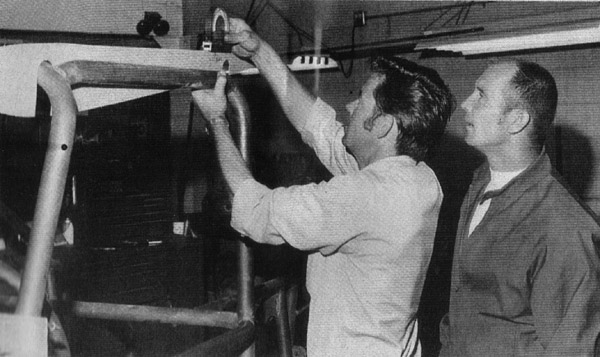
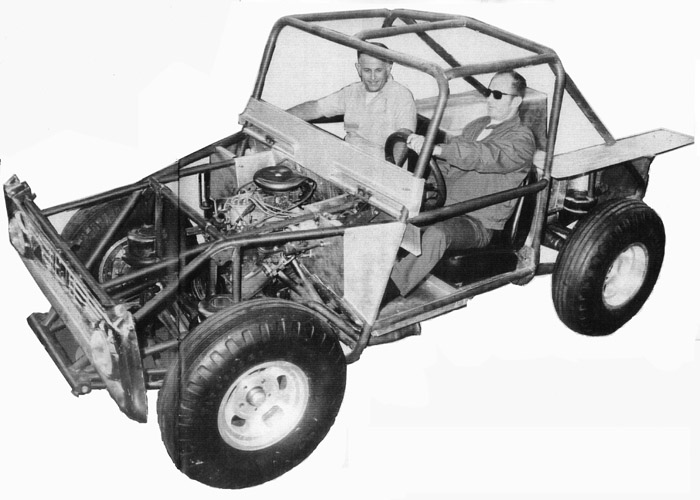
The backbone of Big Oly is a TIG-welded 4130 chrome-moly frame. The frame was built without any of the CAD programs, finite element analysis tools or other electronic blueprints common in today's vehicle construction. Aluminum body panels form the interior body shell of the truck. Look closely at the interior in the pictures and you'll see a stock Bronco glove box door in front of the passenger. The fiberglass outer body shell is a replica of a Bronco body that has been sectioned three inches and narrowed three inches. For about the first two years, the truck had a chrome Bronco grill with the letters "PJ" centered just under the hoodline. Later, a cleaner design, which held 4 off-road lights, was added, along with a tubular pushbar.
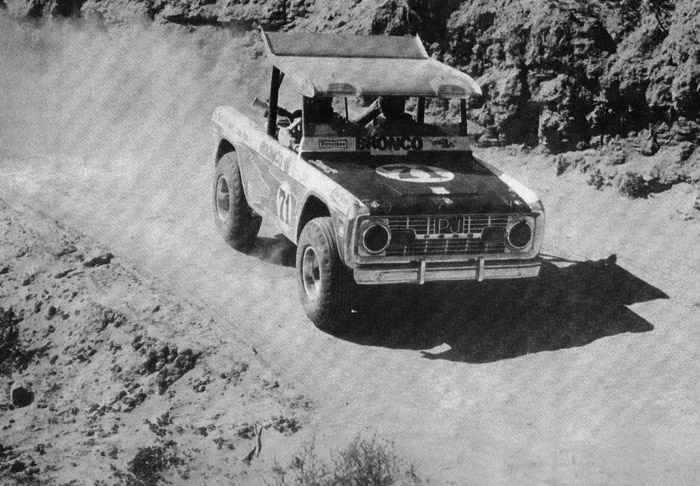
The front end is a Twin-I-Beam front suspension, narrowed either 6 inches, or half an inch(depending on the source) from a production pickup front end. The fore/aft locating members are markedly different from production pieces though. While stock Ford Twin-I-Beam front ends use radius arms that attach to the frame behind the axle beams, Big Oly uses trailing arms that attach at the front of the tube frame and run rearward to the axle beams. This design would appear to allow a more natural deflection of the wheels when encountering obstacles. The front end is directed with the help of a Thunderbird steering box controlled by one of Stroppe's trademark padded Bronco steering wheels. The rear suspension is a four link design with a transverse panhard rod for lateral location of the axle. Each link has rubber bushings at each end. The rear axle is a full-floating 9" design, with 4.11 gears and a Detroit Locker differential. Hurst/Airheart disc brakes are used at each corner. The chassis is suspended by a coil spring at each corner with a Gabriel shock absorber located in the center of each coil spring along with an Gabriel additional shock at each wheel. The front suspension boasts about 10-12" of suspension travel with the rear contributing about 8-10" of travel. An additional note on suspension travel, Big Oly originally had Bostrom suspension seats in it, which had about 3"of spring travel in them for added comfort. At some point they were replaced by modern Taylor seats like those used in off road racing vehicles today. Rolling stock consists of alloy wheels with 9-15 Firestones up with front and 9.50-16 Firestones throwing rocks out the rear.
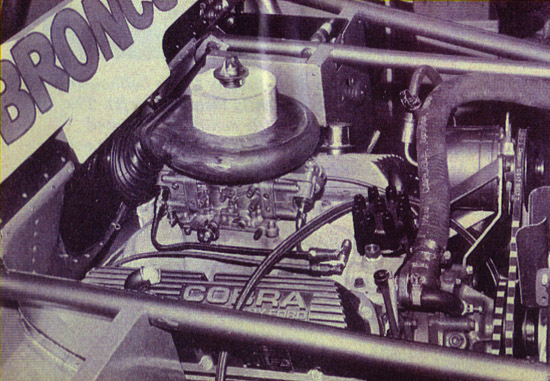
Compared to the fire-breathing 700-800 hp of today's typical Trophy Truck, Big Oly made do with the "miserly" 350-400 hp output of its well-tuned and reliable 351 Windsor V8. Breathing begins up top with a Holley 650 double pumper on a Ford Cobra high rise single plane aluminum manifold. Isky's finest bumps open the valves and Jerry Belanger crafted headers to carry the spent exhaust gases. Behind the healthy Windsor, Jones ran a truck C4 3-speed automatic transmission in the early races but later switched to a stronger C6, which still resides in the truck today. Both transmissions were shifted by a Hurst shifter in a custom-made console between the seats that also houses all the vehicle's Stewart Warner gauges and electrical switches. The oil and transmission coolers were originally from Harrison but switched quickly to Rapid Cool. Filtration is handled by Purolator products and Autolite wiring provides spark for all electrical functions. Handling the fuel containment duties are two 22 gallon Firestone fuel cells. One is mounted directly behind the passenger compartment and the other resides low in the rear of the vehicle behind the rear axle, to aid in weight distribution. The higher mounted cell feeds the lower cell with the aid of gravity. An electric fuel pump moves the fuel to the engine through braided stainless lines. As an item of interest, Big Oly, in its Crazy Colt incarnation, ran at least its first race under propane power. Stroppe experimented with propane power in several of his rigs in the early '70s. Along with the vehicle's fuel, liquid refreshment for the drivers is provided for the driver and co-driver from two Coleman jugs mounted behind the seats.
The most unique feature of Big Oly is of course the large aluminum wing mounted atop the passenger compartment. The wing came from Parnelli's feeling that the rear end of the Pony was a bit loose and that perhaps a wing would give more "bite" at higher speeds. The wing has a range of 40 degrees of adjustability and is adjustable in 10 degree increments from a lever in the cab. Some stories claim that the wing generated enough force to rip a person's arm off at top speed if someone was so inclined to extend a limb in that general area. When questioned about it, Jones said he doubted that was possible, but did feel it helped in the handling department.
Parnelli Jones and Bill Stroppe raced Crazy Colt/Big Oly for four short years from 1970-1974 and in the process built a legendary partnership that is unparalleled in off-road racing history. Big Oly became probably the most famous off-road racing vehicle to ever touch the Baja soil and even today draws crowds whenever it is brought out for display. Parnelli Jones still owns Big Oly, along with his other racing vehicles from over the years. The legendary truck is often on display at the Fabulous Fords Forever show in Buena Park, California.
Sources:
Parnelli Jones. Conversations with the author: September 2000, April 2001.
Boss: The Bill Stroppe Story. Tom Madigan. Darwin Publications. 1984.
Hot Rod Magazine. August 1971.
Off Road Vehicles Magazine. January/February 1971.
Dune Buggy Magazine. December 1970.
- Todd Zuercher
Phoenix, AZ
May 2001