Stroppe Racing Broncos: Pony's Rise and Fall
by Todd Zuercher
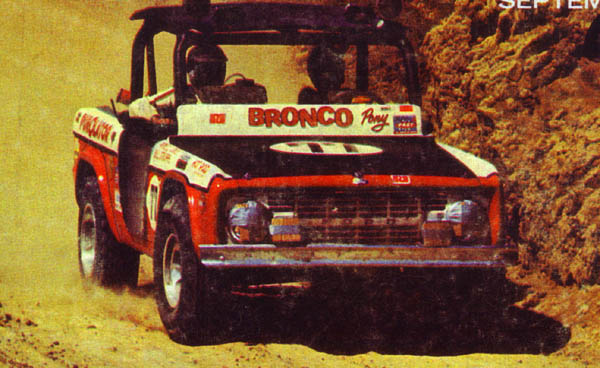
UPDATE: PONY has been found! Check back for a update here soon!! The late 1960s were era referred to in the Ford Motor Company's history as the 'Total Performance' years. With an an exuberant burst of factory-produced horsepower, cars such as the Boss 429 Mustang, Shelby GT500KR, and big-block powered Galaxie 500s roared off the showroom floors and into the garages and hearts of Ford enthusiasts across the country. The Big Three knew the end of the horsepower race was in sight and it seemed as if they wanted to release one last burst of raw power before the upcoming Federal regulations tightened the clamps on emissions output and tightened safety standards.
The man responsible for the fast Fords of the late 1960s, and the Boss 302 and Boss 429 Mustangs in particular, was a man named Semon E. 'Bunkie' Knudsen. Knudsen had made his mark in many years of service at General Motors, but was wooed away by Henry Ford II and came to Ford in 1968. Knudsen's tenure at Ford was short-lived, as he lost the battle for ultimate control of Ford to Lee Iacocca. However, his short rein produced an interesting vehicle for the lores of early Bronco history that far outlived Knudsen's tenure at the helm of the Ford Motor Company.
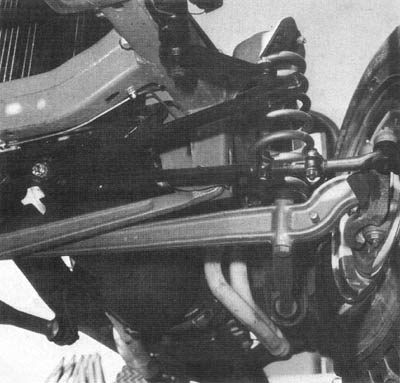
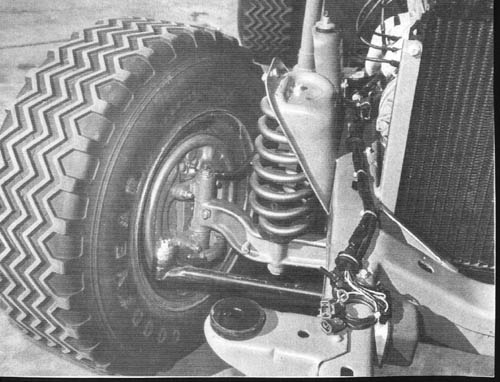
According to Tom Madigan's seminal work on Bill Stroppe, Boss: The Bill Stroppe Story, Knudsen wanted to offer the Bronco in a 2WD kit form with a Twin-I-Beam front end and a plastic body. The kit could be purchased and assembled by the owner. However, Knudsen left Ford in 1970 in the wake of the aforementioned power struggle and the 2WD Bronco kit idea was shelved. According to Parnelli Jones, Ford offered the remains to Stroppe and he accepted them. The earliest photos accompanying this article are believed to show this truck in the kit form shortly after it arrived at Stroppe's shop. The rollbars and dash structure resemble that of a Dearborn show vehicle rather than the race truck which was soon to wear Stroppe colors. However, the Twin-I-Beam suspension is seem clearly along with the C4 automatic transmission; two hallmarks of upcoming Stroppe successes. Although the construction timeline of the truck is not totally clear, it is believed to have been constructed in late 1969. While Madigan's book says it was not ready in time for the 1969 Mexican 1000, two period publications printed photos of it and stated it was entered, but dropped out due to driveline problems. At this race, it was referred to as the 'Colt'. Despite the lack of success in its first outing, Stroppe still scored big when Larry Minor and Rod Hall scored their infamous overall win in the Stroppe-prepped 'Motor Trend' 4WD Bronco.
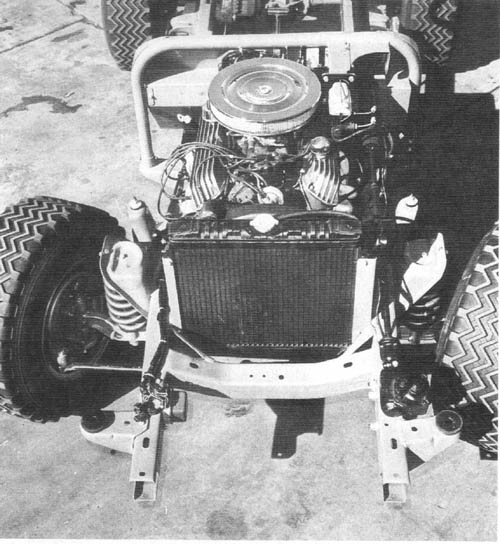
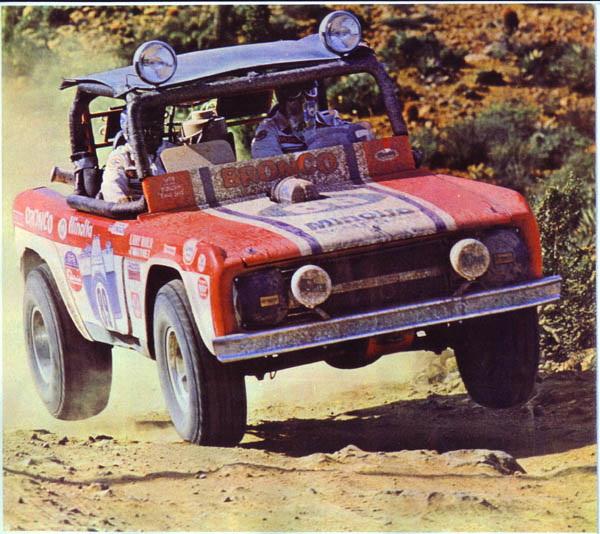
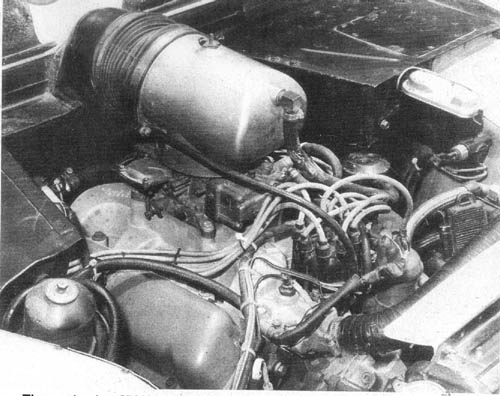
Stroppe built the Pony with many of the same trademark details and components that had made his trucks notoriously reliable in just a few years. The stock Bronco frame and stock rear axle, along with the Twin-I-Beam front end, made up a simple rolling chassis. To this Stroppe added a familiar rollcage with mess screen on top, Bostrom suspension seats, dual Gabriel shocks at each corner, Air Lift airbags, off road lights, and a high performance 302 engine. The engine featured a Ford 'High Performance Pack', which consisted of heads, cam, intake manifold, and a Holley 750 4 barrel carburetor. Backing the small block V8 was a stock C4 truck transmission with gears selected by a Mustang floor shifter. Since the transfer case was no longer needed, the engine and transmission assembly was shifted rearward 10-12 inches to give the vehicle better weight distribution. The engine breathed through an air cleaner located, in standard Stroppe fashion, in the passenger compartment. The driver and co-driver relied on a minimum of gauges including a 150 mph police speedometer and odometer for checking mileage on maps. The Pony was one of Stroppe's first Broncos to feature power steering. Controlled by a familiar foam-dipped steering wheel, this upgrade was greatly appreciated by Stroppe's drivers who no longer had to fear for their thumbs at each rough spot in the road.
The most visible difference between the Pony and the regular Broncos was the difference in the overall height of the body. Three inches of height were removed from the body just below the beltline. This had the effect of 'shoving' the fenders up, giving the unique look. These proportions proved to be just right for the 2WD trucks and Stroppe's future hits like Big Oly and Boss Hoss(Bill Rush's truck) copied the dimensions with their fiberglass body panels. The rear had several inches removed from the frame, the stock taillight housings removed, and the tail squared off. The remaining stock Bronco steel body pieces included the cowl, floorpans, door jams, and rear fender panels. Stroppe built aluminum inner fenders front and rear and added fiberglass front fenders, hood, and door inserts. These modifications all added to an 800 lb. reduction in weight from the 4WD trucks.
Rod Hall and Chuck Looper brought home Pony's first trophy with a first place finish at the 1970 Mint 400, but it was the truck's second victory that brought it fame and a place in the history books. After spending several years pounding the wheels off 4WD Broncos, Parnelli Jones and Bill Stroppe teamed up in Pony for the 1970 Baja 500. The result was beautiful: an overall win with a time of 11 hours and 55 minutes. They covered the 557 mile course beating the previous record by more than three hours. The Stroppe team quickly added lettering to the windscreen proclaiming the victory. This same lettering remained on the truck for the rest of its life.
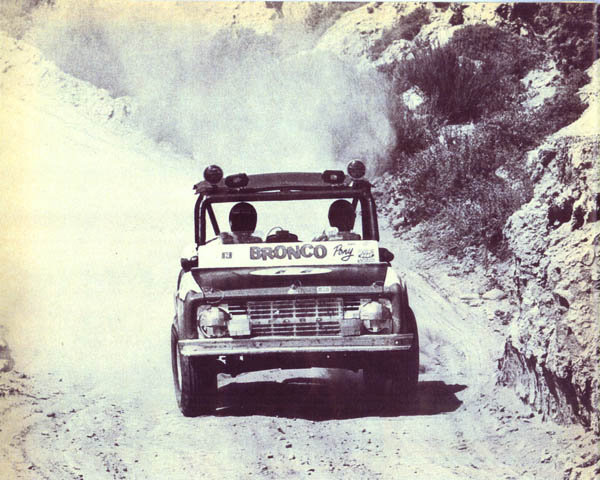
After the Baja 500 race, Parnelli concentrated on readying Big Oly and the Pony was handed off to Stroppe's #2 driver: Larry Minor. Minor gladly took over the wheel after piloting 4WD Broncos with much success for several years. Larry Minor and his co-driver, Jack Bayer, appeared in the winner's circle numerous times in the little red and white truck over the next several years. In 1971, Bill Stroppe experimented with propane power and so the Pony ran on propane for a few races. In addition to frequent excursions in the desert, Minor also raced the truck in the Riverside short course off road events. Changes during this time were minimal. In 1972, the Pony received a new red, white, and blue paint job and picked up a major sponsor in Minolta cameras. It appeared in several popular Minolta photo contest ads during the next two years.
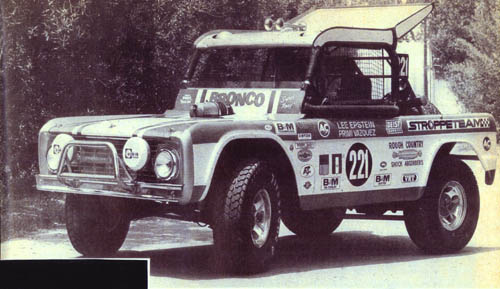
Sometime during 1974 or 1975, the Pony was sold to Lee Epstein. Epstein had Stroppe prep the truck and had several upgrades added to the truck at the same time. The 'Pony' became the 'Super Pony' and acquired a 351W V8 with more horsepower than its original 302. The combination steel/fiberglass fenders and bedsides were replaced with one piece body panels ala Big Oly. Also very evident in the photos of the revamped truck is a large wing similar to Big Oly's. Two fold-down off-road lights were hidden in the wing. To satisfy the larger engine's appetite for fuel, the fuel capacity was doubled by the addition of a 44 gallon fuel cell. The old Gabriel shocks were replaced by Rough Country units(3 at each rear corner) and front and rear sway bars were added to limit body roll. Disc brakes on the front end helped stop the truck in a way the old drum units never could.
Sadly, the story on the Pony goes cold and disappears at this point. Conversations with Willie Stroppe have led the author to conclude the truck was raced several times before rolling and being totalled during one of the Baja races in Mexico in the mid-'70s.
Although it almost always lived in the shadow of its more famous counterpart, Big Oly, the Pony represented an advancement in off road racing trucks when it was first developed and raced. Its place in the history of off-road racing and hearts of Stroppe fans is secure.
Sources:
Parnelli Jones. Conversations with the author: September 2000, April 2001.
Willie Stroppe. Conversations with the author: September 2000, April 2001.
Boss: The Bill Stroppe Story. Tom Madigan. Darwin Publications. 1984.
Hot Rod Magazine. August 1971.
Off Road Vehicles Magazine. January/February 1971.
Dune Buggy Magazine. December 1970.
- Todd Zuercher
Phoenix, AZ
May 2001